Understanding Hair Loss
Beyond Hair & Culture gives you a clear foundation so you can navigate hair loss with more confidence and fewer guesse
What are the early signs of hair loss?
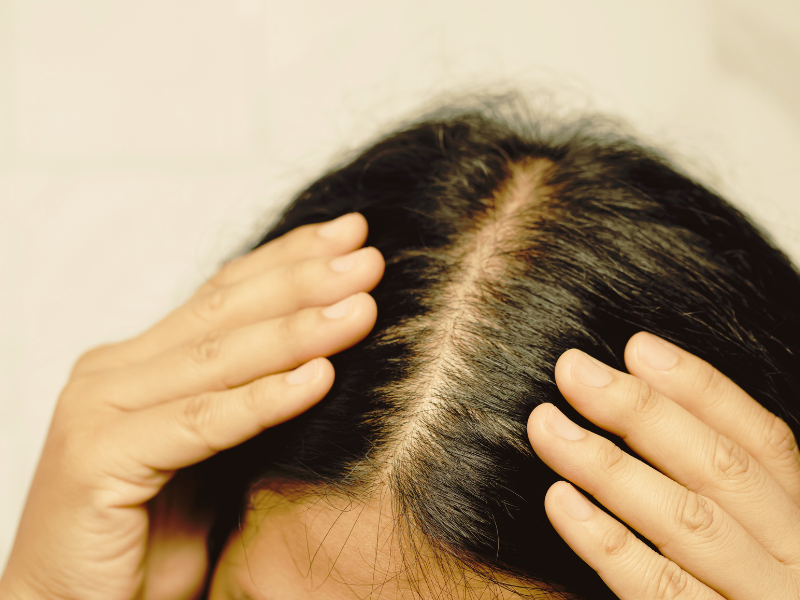
Early signs rarely look dramatic. They appear quietly, often long before you notice a visible change. You might observe more strands on your brush or shower floor. You may feel your ponytail shrinking, not suddenly, but across many weeks. Some people notice that their part looks thinner under direct light. Others feel a new sensitivity on the scalp, especially near the crown or temples. These clues matter because understanding hair loss at an early stage helps you identify its nature before it progresses.
Your hair density does not decline evenly. Certain regions respond faster to shifts in hormones, stress, inflammation, or internal changes. When you pay attention to small alterations, you gain insight into the pattern behind them. Early awareness helps you distinguish between temporary shedding and something more persistent.
If you want a clearer overview of these distinctions, the BHC guide on acute vs. chronic telogen effluvium breaks down the clues that appear in the first months. You can also explore our article on the origins of hair loss myths, which explains why early signs are often misunderstood. Understanding hair loss begins with noticing what your scalp has been trying to show you.
Why do hair loss patterns differ between men and women?
Men and women experience hair loss differently because their follicles respond to specific hormonal environments. Androgens play an important role in this process. In many men, receptors on the temples and crown react more strongly to these hormones, which explains the classic “M-shaped” recession. Women carry the same hormones, but their follicles react with greater subtlety. Thinning appears as a broad reduction of density across the midline rather than a sharp retreat.
These differences don’t make one pattern more severe than the other. They simply reflect how each scalp interprets hormonal messages. Lifestyle choices, medical conditions, and genetic traits add another layer, shaping how quickly each pattern develops. This is why two people with the same family history can experience entirely different trajectories.
Understanding hair loss across genders helps you read your own pattern with more accuracy. It also prevents unnecessary worry. For example, women often fear “bald spots” when they’re seeing diffuse thinning, while men may misinterpret temporary shedding as permanent change.
If you want to explore the biology behind these variations, our article The link between stress and hair loss explains how internal pressures interact with hormonal pathways and influence these visible patterns.
How much shedding is considered normal per day?
Daily shedding is a natural part of the hair cycle. Most people lose between 50 and 100 strands each day, although a wider range can still remain normal. Shedding increases during washing, brushing, or seasonal transitions. You might see more hair in late autumn or early spring, which often reflects natural cycles rather than a problem. Understanding hair loss requires observing the rhythm of your shedding rather than counting every strand.
Normal shedding feels consistent. It does not escalate quickly, and it rarely creates sudden gaps. When shedding increases abruptly and continues for several weeks, the cause may involve stress, illness, nutritional shifts, or medication. Even then, many cases remain temporary because the follicles stay active beneath the surface.
You can evaluate your shedding by focusing on the pattern, not the number. Ask yourself whether the volume has changed notably in recent weeks. Monitor how your hair behaves during routine care. When shedding rises and stays high for several months, it’s helpful to look deeper.